Free Government iPhone in Georgia: Lifeline, EBT, Medicaid and Safe Application Help
Georgia residents can check free or discounted phone options through Lifeline-related provider offers, but there is no verified statewide Georgia program that guarantees a free iPhone to every eligible person. EBT, SNAP, Medicaid, SSI, income eligibility, and certain other programs may help you qualify for Lifeline service, while the actual phone offer depends on provider rules, ZIP code, stock, shipping, activation, and device terms.
Quick answer for Georgia residents
Lifeline is still active in Georgia. ACP ended, and households stopped receiving ACP discounts after June 1, 2024. SNAP/EBT and Medicaid can help prove Lifeline eligibility, but they do not guarantee an iPhone. Many Georgia Lifeline phone offers are Android phones, basic smartphones, or service discounts. iPhones, when available, are usually provider-specific, limited, refurbished, promotion-based, or ZIP-code dependent.
Lifeline Free iPhone is an independent informational resource. It is not a government agency, the FCC, USAC, Apple, or a Lifeline provider.
On this Georgia page
Use this page to understand what is realistic, what documents may be needed, and where to check next without giving sensitive data to unsafe websites.
Quick Answer for Georgia Residents
If you live in Georgia and searched for a free government iPhone, here is the most honest way to think about it: Lifeline may help you get discounted phone or internet service, and some participating providers may offer a free or discounted smartphone with service. The government does not guarantee an iPhone to every eligible Georgia resident.
SNAP, often called food stamps, Medicaid, SSI, FPHA or Section 8, Veterans Pension, Survivors Benefit, qualifying Tribal programs, or income at or below 135% of the Federal Poverty Guidelines may help you qualify for Lifeline. In Georgia, many people use Georgia Gateway notices, DFCS SNAP proof, Medicaid or PeachCare for Kids proof, or other public benefit documents during the eligibility process.
Lifeline is active
Lifeline can reduce the cost of phone, internet, or bundled service for eligible households. It is generally limited to one benefit per household.
ACP ended
The Affordable Connectivity Program ended because of lack of additional funding. ACP households stopped receiving ACP discounts after June 1, 2024.
iPhone offers vary
Some provider ads may mention iPhones, but stock, model, condition, fees, shipping, activation, and ZIP-code availability must be checked carefully.
What "Free Government iPhone" Actually Means in 2026
The phrase "free government iPhone in Georgia" is usually not literal. Lifeline is a federal phone and internet affordability program. It helps eligible households lower the monthly cost of service. The phone itself, if offered, usually comes from a Lifeline provider's promotion, device policy, inventory, or activation package.
That difference really matters. A Georgia resident may qualify for Lifeline and still see an Android phone instead of an iPhone. Another resident in a different ZIP code may see a discounted refurbished iPhone offer, a bring-your-own-phone option, or no device offer at all. Provider terms can change quickly, and a phone shown in an advertisement may not be available after the ZIP-code check.
That is why this page does not promise an Apple device. It shows how Georgia residents can check eligibility, compare provider options, read terms, protect personal information, and understand safer alternatives if no iPhone is available.
Realistic device expectations
- Android smartphones are more common than iPhones.
- iPhones may be refurbished or limited-stock.
- Some offers may require activation, shipping, or copay costs.
- Provider availability can change by ZIP code.
- Eligibility approval does not guarantee a specific phone model.
- Read terms before choosing a provider.
Important Georgia safety note
Be careful with any website, social post, or message that says "guaranteed free iPhone today," "official government iPhone," or "pay first to unlock approval." A real Lifeline process should not ask for your EBT PIN, bank card, or payment app login.
Does Georgia Have a Free iPhone Program?
No verified official statewide program in Georgia guarantees a free iPhone to every eligible resident. Georgia residents should be skeptical of any wording that makes a device sound like an automatic state benefit.
The safer path is to check Lifeline eligibility, then compare participating providers by ZIP code. Some providers may advertise free phones, discounted smartphones, upgraded devices, 5G phones, or refurbished iPhones. Those are provider offers, not a blanket Georgia government iPhone program.
Georgia residents may also use local digital access resources if they need internet access to apply, upload documents, or compare providers. Public libraries, community action agencies, broadband resources, and assistive technology programs can help residents who have limited home internet, a disability-related access need, or trouble managing online benefits.
Safe Georgia alternatives
- Check Lifeline eligibility through official channels.
- Use ZIP-code tools to find available companies.
- Compare Android, iPhone, refurbished, and bring-your-own-phone options.
- Use Georgia public libraries for internet access when needed.
- Contact local community support if documents are difficult to access.
Claims to treat carefully
- "Georgia government gives free iPhones to everyone."
- "ACP is still paying for your free iPhone."
- "Send your EBT PIN for instant approval."
- "Pay a small approval fee before applying."
- "Only WhatsApp or Telegram support is available."
Main Ways Georgia Residents May Qualify
Georgia residents usually qualify for Lifeline through income or participation in an accepted benefit program. The National Verifier or provider process may need documents if automatic database checks cannot confirm eligibility.
| Qualification route | Georgia example | How it helps | Important caution |
|---|---|---|---|
| SNAP or EBT | Georgia SNAP, also known as food stamps, handled through DFCS and Georgia Gateway | Can help prove Lifeline eligibility | SNAP proof does not guarantee an iPhone |
| Medicaid | Georgia Medicaid, PeachCare for Kids, and related Medical Assistance records | Can help prove Lifeline eligibility | Provider may require current proof, not an expired card |
| SSI | Supplemental Security Income benefit proof | Can qualify a household for Lifeline | Use official benefit proof, not screenshots with hidden details missing |
| Income | Household income at or below 135% of the Federal Poverty Guidelines | Can qualify applicants without SNAP or Medicaid | Pay stubs, tax returns, or benefit letters may need matching names |
| Housing assistance | FPHA or Section 8 proof | Can support Lifeline eligibility | Address mismatch may trigger manual review |
| Veterans or survivor benefits | Veterans Pension or Survivors Benefit | Can qualify eligible households | Use current official documentation |
| Tribal programs | Qualifying Tribal assistance, where applicable | May support Lifeline eligibility and special rules | Most Georgia applicants use regular Lifeline routes, but qualifying documents should still be reviewed |
Georgia household rule reminder
Lifeline is generally limited to one benefit per household. Roommates, shared housing, extended families, and multi-family homes in Georgia may need to show whether they share income and expenses or operate as separate households.
EBT and SNAP Free iPhone Options in Georgia
Georgia SNAP, also known as food stamps, helps eligible households pay for groceries. For Lifeline, SNAP participation can also help prove eligibility. That is exactly why so many residents search for a free iPhone with EBT in Georgia.
The limit here is simple: EBT can help with eligibility, but it does not force a provider to hand over an iPhone. A Georgia SNAP recipient may qualify for Lifeline service and receive an Android phone offer, a basic smartphone offer, a service discount, or a provider-specific device option.
Many Georgia residents manage benefit notices through Georgia Gateway. If the Lifeline system or provider cannot verify SNAP automatically, you may need a current notice, benefits letter, or account proof that shows your name, program, and active benefit status. Do not send your EBT PIN to any phone seller or agent.
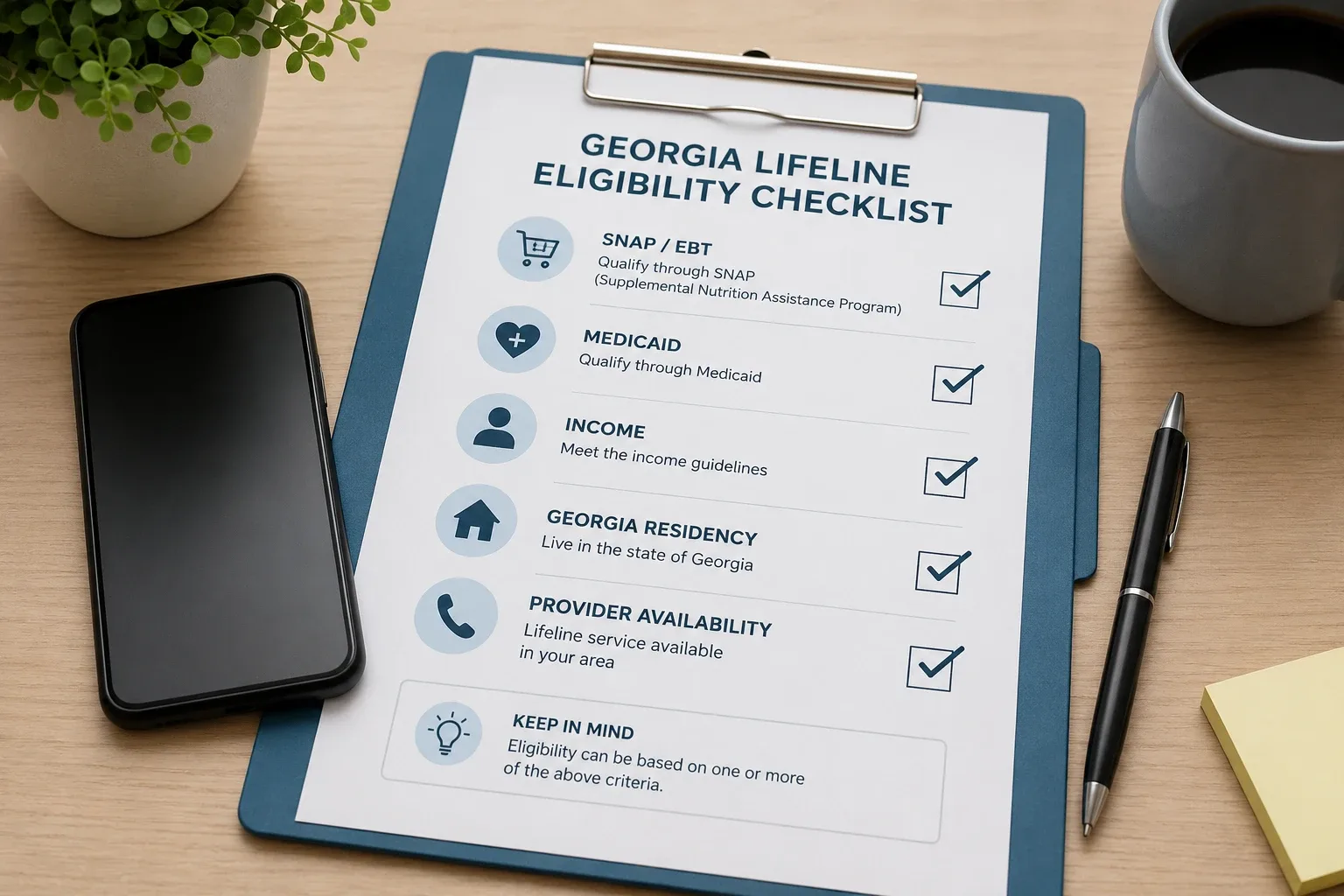
Use current benefit proof. Expired notices, old addresses, or mismatched names can delay manual review.
Common Georgia SNAP document issues
- The name on the SNAP notice does not match the Lifeline application.
- The applicant recently moved from one Georgia county to another.
- A benefits screenshot does not show enough detail.
- The household uses a mailing address that differs from the service address.
- The document is too old or does not show current participation.
Medicaid Free iPhone Options in Georgia
Georgia Medicaid and PeachCare for Kids are important eligibility routes for many low-income households. If you or a child in your household participates in Medicaid, that participation may help prove Lifeline eligibility.
Medicaid does not guarantee an iPhone. The Lifeline eligibility check and the provider device offer are two separate things. A Georgia Medicaid member may qualify for Lifeline, but the available phone could be Android, refurbished, limited by inventory, or tied to a provider's service terms.
If a provider or verifier asks for proof, Georgia residents may need a Medicaid approval letter, benefits notice, managed care letter, Georgia Gateway proof, or an accepted account screenshot. The document should show the applicant's name, active status, program name, and enough detail to prove current eligibility.
Georgia Medicaid
May help adults, children, pregnant applicants, people with disabilities, and other eligible groups prove Lifeline eligibility.
PeachCare for Kids
Child coverage proof can matter because Lifeline can allow qualification through a child or dependent in the household.
Georgia Pathways
Some adults may see Georgia Pathways to Coverage in the state system. Use current proof if it is accepted for your situation.
Lifeline iPhone and Free Phone Options in Georgia
Lifeline is the main federal program Georgia residents should understand before applying for a free or discounted phone. The FCC oversees the program, and USAC administers it. In most states, including Georgia, the National Verifier handles eligibility checks.
After eligibility gets approved, the resident still needs a participating phone or internet company. USAC's Companies Near Me tool lets users search by ZIP code, city, and state. That step matters because a provider may serve one Georgia area and not another. A provider may also offer different device terms in Atlanta than in rural South Georgia or the North Georgia mountains.
Do not judge an offer by the headline alone. Compare monthly service, data, talk and text, device condition, activation cost, shipping cost, copay, replacement rules, transfer rules, and recertification requirements.
Provider check shortcut
Use the provider comparison page to understand what to compare before selecting a Lifeline company in Georgia.
Phone and Internet Access Issues Across Georgia
Georgia is not one single phone market. Residents in Atlanta, Augusta, Columbus, Macon, Savannah, Athens, Sandy Springs, Roswell, Albany, Johns Creek, Warner Robins, Gainesville, Valdosta, Rome, and Brunswick may see different provider options because Lifeline availability is checked by ZIP code.
Metro Atlanta residents may see more provider choices, but that does not guarantee iPhone inventory. Rural counties in South Georgia, mountain communities in North Georgia, and coastal areas near Savannah and Brunswick may face different coverage, shipping, and service reliability issues. College towns such as Athens and Statesboro may also have adult learners, workers, and shared-household applicants who need clear document guidance.
Georgia residents who do not have reliable home internet can use public access points before choosing a provider. Georgia public libraries offer free high-speed internet and Wi-Fi, and many libraries can help residents get online, check email, upload documents, or use public computers. Georgia's broadband work also points to digital equity and broadband planning efforts through the Georgia Technology Authority.
For residents with disability-related technology needs, Georgia's Tools for Life program can help with assistive technology access. Community Action Agencies may also help households connect with local support, especially where transportation, paperwork, energy bills, or benefit access are difficult.
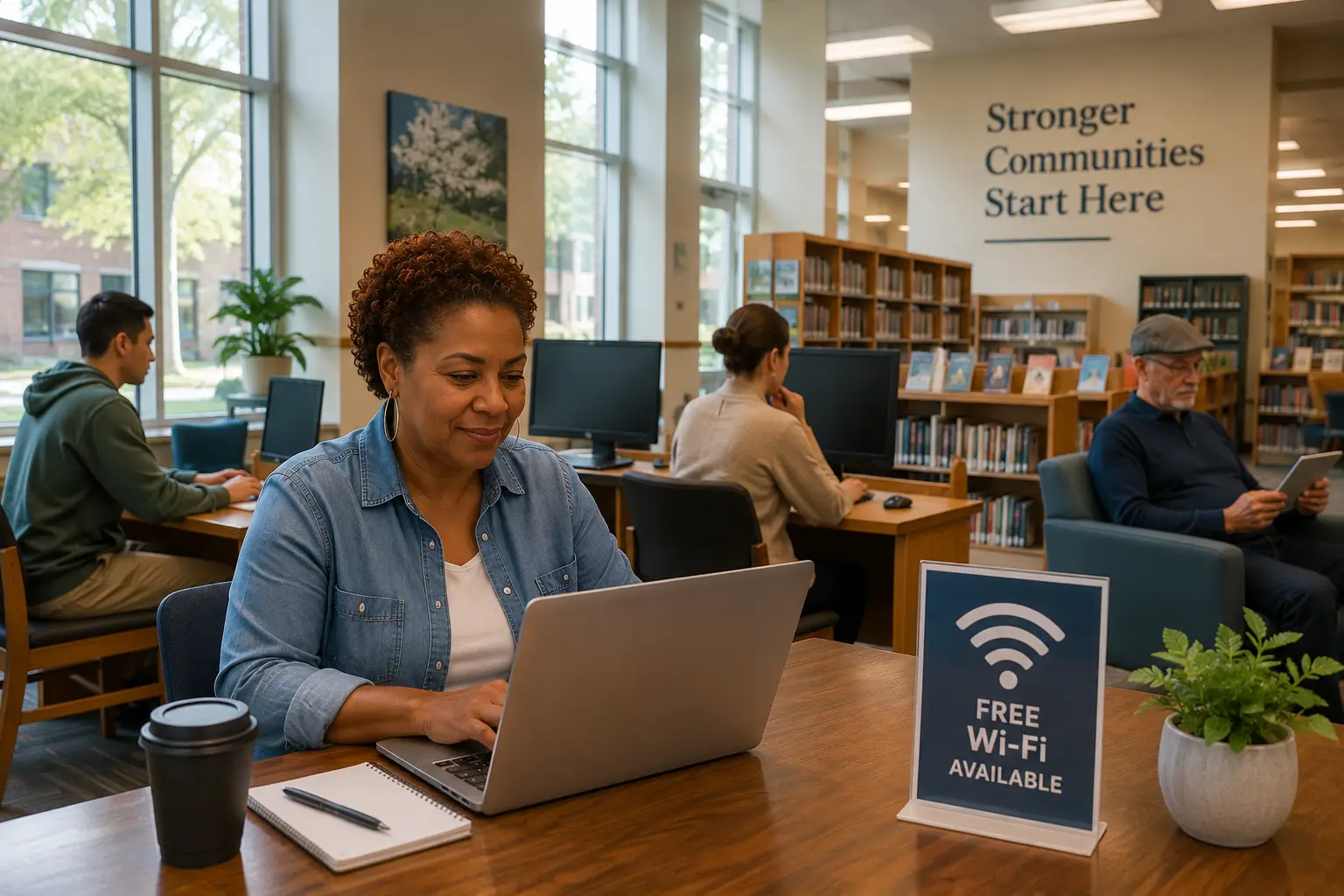
Public libraries can be useful if you need a safe internet connection to compare providers or access Georgia Gateway notices.
Local Georgia problems that can affect applications
- Rural address or PO Box mismatch.
- Recent move between counties.
- Benefit letter lists a child or dependent, not the adult applicant.
- Phone service is available, but device shipping is limited.
- Provider coverage is weak at home, even if the company serves the ZIP code.
- Applicant needs library internet to upload proof or check email.
Safe Path to Check Lifeline iPhone Options in Georgia
Run through this simple route before trusting any "free iPhone" claim. It keeps the focus on eligibility, provider availability, device terms, and scam protection.
Confirm eligibility
Check SNAP/EBT, Medicaid, SSI, income, housing, veterans, survivor, or qualifying Tribal eligibility.
Use official Lifeline route
Use Lifeline, National Verifier, or a legitimate provider process. Keep your documents current.
Search by ZIP code
Georgia provider options can change between Atlanta, Augusta, Savannah, Macon, and rural counties.
Compare device terms
Check iPhone stock, Android backup options, 5G support, refurbished condition, fees, and shipping.
Apply through safe channels
Use official Lifeline tools or real provider websites. Save confirmation emails and notices.
Avoid scam claims
Never share your EBT PIN, bank details, payment app login, or sensitive data with social-media agents.
Documents You May Need
Not every Georgia applicant needs to upload documents. If the National Verifier or provider cannot confirm eligibility automatically, manual review may require proof. Prepare clean, current documents before applying.
| Document type | Examples | Georgia-specific note |
|---|---|---|
| Identity proof | Driver's license, state ID, passport, or other accepted identity document | Name should match the application exactly |
| Address proof | Utility bill, lease, government letter, or accepted address document | Rural addresses, PO Boxes, or recent moves may need extra care |
| SNAP or EBT proof | Georgia Gateway notice, DFCS letter, current SNAP proof | Do not send EBT card PIN or card number to phone sellers |
| Medicaid proof | Georgia Medicaid notice, PeachCare for Kids proof, Medical Assistance record | Document should show active coverage or current participation |
| Income proof | Pay stubs, tax return, unemployment statement, benefits letter | Use household income proof that matches the Lifeline household |
| Household worksheet | Lifeline household worksheet if someone at your address already has Lifeline | Shared homes, roommates, and extended families may need this |
| Tribal documents | Qualifying Tribal assistance documentation, where applicable | Use only if it applies to your household |
Apply Now in Georgia, Safe Guided Path
This is not a government form, and Lifeline Free iPhone does not collect SSNs, EBT card numbers, EBT PINs, bank details, dates of birth, addresses, or phone numbers on this page. Use this section as a safe checklist before you visit official Lifeline tools or provider websites.
Eligibility pre-check
Do you have SNAP, Medicaid, SSI, housing assistance, veterans benefits, survivor benefits, or income-based eligibility?
Document readiness
Do your name, address, benefit proof, and household information match your application?
ZIP-code provider check
Check your exact Georgia ZIP code before trusting a statewide device claim.
Device expectation
Compare iPhone, Android, 5G, refurbished, copay, activation, shipping, and service terms.
Approval and iPhone stock are not guaranteed. Always read provider terms before submitting an application.
Provider Availability and ZIP Code Checks in Georgia
ZIP code matters more than most people expect. A provider may advertise Lifeline service in Georgia but still have different offers by county, city, network coverage, shipping rules, or device inventory. One resident in Fulton County may see a different set of options than someone in Dougherty, Muscogee, Bibb, Chatham, Richmond, Hall, Lowndes, Floyd, or Glynn County.
iPhone stock can also change fast. Some providers may list iPhone-related offers during one promotion and pull them later. Others may offer Android phones more often because they are cheaper to supply through free-phone plans.
Before choosing, compare monthly service, data amount, hotspot rules, talk and text, device type, whether the phone is new or refurbished, activation fees, shipping fees, copay, replacement policy, customer support, and recertification rules.
What To Do If No iPhone Offer Is Available
If you qualify for Lifeline but cannot find a real iPhone offer in your Georgia ZIP code, you still have practical options. The first priority is reliable communication, not a risky phone promise.
Safer options
- Accept a Lifeline phone or service discount first if it meets your needs.
- Compare Android smartphone offers, especially if they include 5G support.
- Check free 5G government phone options.
- Buy a low-cost refurbished iPhone separately if you can confirm network compatibility.
- Use public library computers or Wi-Fi to manage applications and email.
- Contact a local Community Action Agency if paperwork or internet access is a barrier.
What not to do
- Do not pay a suspicious approval fee.
- Do not share your EBT PIN.
- Do not trust fake ACP offers after ACP ended.
- Do not assume "iPhone 13" means guaranteed model availability.
- Do not submit documents to a site with no clear company details.
If you are researching a specific iPhone model, read the device expectations on the free iPhone 13 page before assuming that a model is available in Georgia.
Special Groups in Georgia
Seniors
Georgia seniors may qualify through Medicaid, SNAP, SSI, income, or other eligible benefits. A simple smartphone may be more useful than chasing a risky iPhone promise. See the seniors guide for safer expectations.
Families with EBT
SNAP participation can support Lifeline eligibility, especially for families that need a phone for school, work, health appointments, and benefit notices.
Medicaid households
Medicaid proof may help the household qualify, but it does not guarantee iPhone stock. Keep current Georgia Medicaid or PeachCare documentation ready.
Rural residents
Rural South Georgia and North Georgia applicants should check coverage carefully. A provider may approve service but still have weak coverage at the home address.
Students and adult learners
Students in Athens, Atlanta, Statesboro, Macon, Savannah, and other college areas should check household rules if they share housing or move often.
People with disabilities
Residents who need accessibility support can also check Georgia assistive technology resources. Lifeline phone choice should match accessibility needs, not only brand preference.
Scam Warnings for Georgia Residents
Phone assistance searches attract scams because applicants may be worried, rushed, or dealing with limited internet access. Slow down before sending private information.
Warning signs
- "Guaranteed free iPhone today" claims.
- Fake government logos or fake approval stamps.
- ACP claims that ignore the fact that ACP ended.
- Requests for EBT PIN, bank details, card details, or payment app login.
- "Pay first to unlock approval" messages.
- Social media-only sellers with no real provider information.
- WhatsApp or Telegram-only agents.
- Fake tracking numbers before any real application is approved.
- Copied provider names that send users to unrelated websites.
- Sites that hide contact information, terms, and privacy details.
Helpful Checklist Before You Apply
- Confirm SNAP, Medicaid, SSI, income, housing, veterans, survivor, or other eligibility.
- Check the Lifeline one-benefit-per-household rule.
- Gather current documents before starting.
- Make sure your name and address match across documents.
- Compare providers by your exact Georgia ZIP code.
- Read device terms before choosing a provider.
- Check iPhone availability, Android backup options, and 5G support.
- Protect your EBT PIN, SSN, and financial information.
- Save confirmation emails, notices, and provider terms.
- Watch for annual recertification notices so you do not lose service.
FAQs About Free Government iPhones in Georgia
Can I get a free government iPhone in Georgia?
Possibly, but it is not guaranteed. Georgia residents may qualify for Lifeline service through income or benefit programs, and some providers may offer free or discounted smartphones. A specific iPhone depends on the provider, ZIP code, stock, device condition, fees, and plan terms.
Does Georgia EBT qualify me for a free iPhone?
Georgia SNAP or EBT can help prove Lifeline eligibility, but it does not guarantee an iPhone. It may help you qualify for Lifeline service, then you still need to compare provider phone offers.
Can Medicaid help me get a Lifeline phone in Georgia?
Yes, Medicaid participation can help prove Lifeline eligibility. Georgia Medicaid, PeachCare for Kids, or related Medical Assistance proof may be useful if accepted by the verifier or provider. It still does not guarantee an iPhone.
Is Lifeline still active in Georgia after ACP ended?
Yes. Lifeline is still active. ACP ended, and households stopped receiving ACP discounts after June 1, 2024. Lifeline and ACP are separate programs.
Are iPhones guaranteed through Georgia Lifeline providers?
No. iPhones are not guaranteed. Many Lifeline providers offer Android phones more often. iPhone offers may be refurbished, limited-stock, promotion-based, ZIP-code dependent, or unavailable.
What if only Android phones are available in my Georgia ZIP code?
Compare the Android offer carefully. A reliable Android phone with Lifeline service may be more useful than a risky iPhone claim. You can also check 5G phone options or buy a compatible refurbished iPhone separately.
Can Georgia seniors apply for a free or discounted phone?
Yes, Georgia seniors may qualify through SNAP, Medicaid, SSI, income eligibility, or other accepted routes. Seniors should compare simple phone usability, coverage, customer support, and document requirements before focusing only on iPhone availability.
Do rural Georgia residents have fewer phone options?
They may. Rural South Georgia, North Georgia mountain areas, and some smaller communities can have fewer provider choices or different coverage quality. Always check your exact ZIP code and network coverage before applying.
Do Atlanta, Savannah, Augusta, and Macon have the same providers?
Not always. Larger cities may show more provider choices, but each offer still depends on ZIP code, provider service area, inventory, and device rules. Do not assume one Georgia city's offer applies statewide.
What documents should I prepare in Georgia?
Prepare identity proof, address proof, benefit proof such as SNAP or Medicaid documentation, income proof if applying by income, and a household worksheet if another person at your address already has Lifeline.
Should I give my EBT PIN to apply for a free iPhone?
No. Never give your EBT PIN, bank details, card number, or payment app login to anyone promising a phone. Lifeline eligibility may require benefit proof, not your EBT PIN.
Where can I get internet access to apply in Georgia?
Georgia public libraries offer free high-speed internet and Wi-Fi, and many libraries provide access to computers or local digital resources. This can help if you need to check providers, upload documents, or read benefit notices.
Final Helpful Summary
A free government iPhone in Georgia is not guaranteed. The realistic path is to check Lifeline eligibility through SNAP, Medicaid, SSI, income, housing, veterans, survivor, or other qualifying routes, then compare providers by exact ZIP code. Expect Android phones to be more common, read iPhone terms carefully, and avoid any site or agent that asks for an EBT PIN, bank details, or an upfront approval fee.
External Resources
Use official or trusted resources for eligibility, provider search, Georgia benefits, digital access, and local support.